Size, gravity and what’s inside
A volleyball next to Earth’s nickel, squashed by its own spin, light enough to float and with nowhere to stand. Here’s Saturn in numbers.
Sixth from the Sun
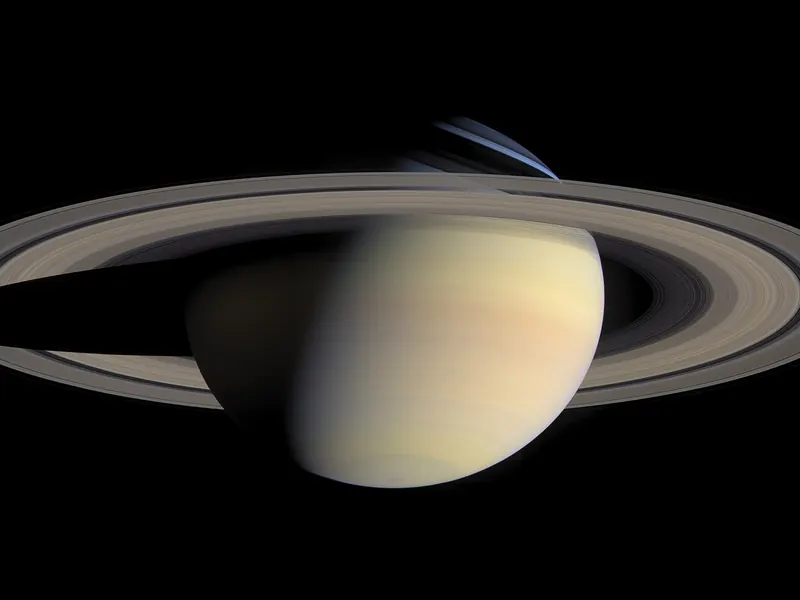
Saturn is the sixth planet from the Sun, and the second largest in the solar system. NASA Science: Saturn facts Like Jupiter, Saturn is mostly hydrogen and helium, the same two main ingredients as the Sun. NASA Science: Saturn facts
Saturn took shape about 4.5 billion years ago, with the rest of the solar system, and settled into its present place about 4 billion years ago. NASA Science: Saturn facts
How big?
Saturn is about 120,500 km wide at its equator: 9 times wider than Earth. NASA Science: Saturn facts If Earth were the size of a nickel (a US 5-cent coin), Saturn would be about as big as a volleyball. NASA Science: Saturn facts
Saturn has 95.16 times Earth’s mass, and Earth would fit inside it about 763 times by volume. NASA NSSDC: Saturn fact sheet
Saturn is visibly squashed: 60,268 km from centre to equator but 54,364 km from centre to pole. NASA NSSDC: Saturn fact sheet ESA says Saturn is flattened at the poles because it spins so fast. ESA: Facts about Saturn
Light enough to float
Saturn’s average density is 687 kg per cubic metre. Earth’s is 5,513. NASA NSSDC: Saturn fact sheet Saturn is the only planet whose average density is less than water’s. NASA says it could float in a bathtub, if a bath that big existed. NASA Science: Saturn facts
Test it for yourself: try the Bathtub Test →
How far?
NASA’s Saturn facts page puts Saturn an average 1.4 billion km from the Sun: 9.5 astronomical units (1 AU is the Sun–Earth distance). NASA Science: Saturn facts
ESA gives a mean distance of 1,429,400,000 km, or 9.6 AU. ESA: Facts about Saturn NASA’s fact sheet gives Saturn’s orbit a semimajor axis of 1,432.041 million km. NASA NSSDC: Saturn fact sheet
Sunlight takes 80 minutes to reach Saturn. NASA Science: Saturn facts
Saturn comes as close as 1,205.5 million km to Earth and gets as far as 1,658.6 million km. NASA NSSDC: Saturn fact sheet
Days and years
Saturn has the second-shortest day in the solar system: about 10.7 hours. NASA Science: Saturn facts NASA’s fact sheet gives the length of a Saturn day as 10.656 hours. NASA NSSDC: Saturn fact sheet
One trip round the Sun, a Saturn year, takes 10,755.699 Earth days. NASA NSSDC: Saturn fact sheet That is about 29.4 Earth years. NASA Science: Saturn facts
Saturn is tilted by 26.73 degrees, not far off Earth’s 23.5, so like Earth it has seasons. NASA Science: Saturn facts
How old would you be in Saturn years? Try “You on Saturn” →
Gravity, and nowhere to stand
At Saturn’s 1-bar cloud level, gravity on average is 1.140 times Earth’s. NASA NSSDC: Saturn fact sheet Spin and squash make a difference: gravity is 0.916 times Earth’s at Saturn’s equator and 1.235 times at its poles. NASA NSSDC: Saturn fact sheet
To escape Saturn’s gravity you would need to go 35.5 km a second. NASA NSSDC: Saturn fact sheet
Saturn has no true surface. It is mostly swirling gases, and liquids deeper down. NASA Science: Saturn facts The pressure and heat deep inside would crush, melt and vaporise any spacecraft trying to fly in. NASA Science: Saturn facts
ESA notes a craft could drift down on a parachute and send data until the pressure crushed it. In the end, that was Cassini’s fate. ESA: Facts about Saturn
Air and temperature
Saturn’s atmosphere is 96.3% hydrogen and 3.25% helium, by volume. NASA NSSDC: Saturn fact sheet
At the 1-bar level, Saturn’s air is −139 °C. NASA NSSDC: Saturn fact sheet
Saturn’s clouds show as faint stripes, jet streams and storms, in shades of yellow, brown and grey. NASA Science: Saturn facts
Inside Saturn
At the centre is a dense core of metals like iron and nickel, wrapped in rock, then liquid metallic hydrogen. NASA Science: Saturn facts
A giant magnet
Saturn’s magnetic field is smaller than Jupiter’s but still 578 times as powerful as Earth’s. NASA Science: Saturn facts
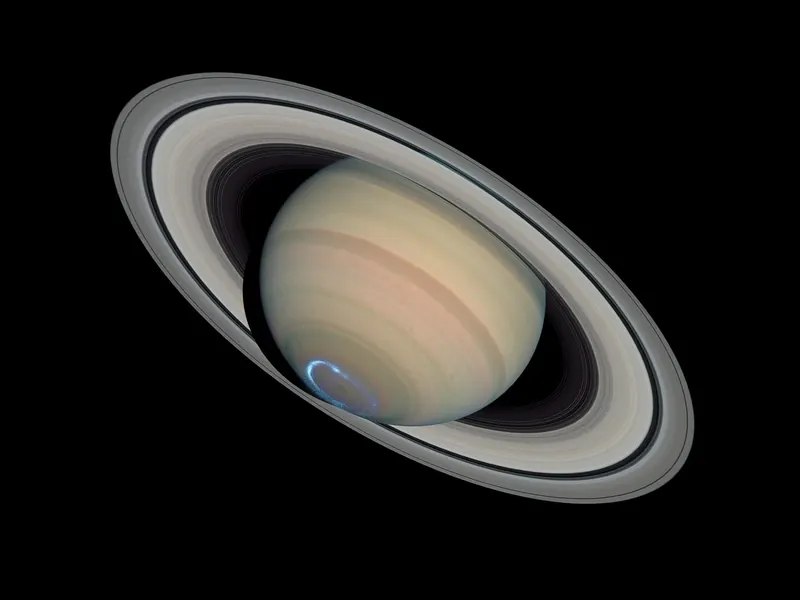
Cassini showed some of Saturn’s auroras are driven not by the solar wind but by particles from its moons and the planet’s fast-spinning magnetic field. NASA Science: Saturn facts
Its name
Saturn is named after the Roman god of farming and wealth, who was also the father of Jupiter. NASA Science: Saturn facts Around 400 BCE Greek astronomers named it after Kronos, god of farming. The Romans later swapped in their own god of farming: Saturn. NASA Science: Saturn exploration
The oldest written records of Saturn come from the Assyrians, around 700 BCE, who called it the “Star of Ninib”. NASA Science: Saturn exploration
Saturn is the farthest planet from Earth that was discovered with the unaided eye, and it has been known since ancient times. NASA Science: Saturn facts
Galileo saw the rings through a telescope in July 1610 but took them for a “triple planet”. NASA Science: Saturn exploration ESA: Saturn’s rings At first Galileo wondered if he was looking at three planets, or a planet with handles. NASA Space Place: All about Saturn
Could anything live there?
Saturn itself is a poor place for life, but two of its moons, Enceladus and Titan, have internal oceans and could possibly support it. NASA Science: Saturn facts · checked 27 Oct 2026
Most Saturn numbers here come straight from NASA’s Saturn facts page and NASA’s Saturn fact sheets. Sometimes official pages disagree, and when they do we show both rather than pick one quietly. Moons: NASA’s Saturn moons page says 293 confirmed (as of August 2026), while NASA’s Saturn facts page, NASA’s fact sheet, NASA Space Place and ESA still say 274. Winds near the equator: 500 m a second on NASA’s facts page, up to 400 m a second on NASA’s fact sheet. Distance from the Sun: 9.5 AU (NASA), 9.6 AU (ESA). The Cassini Division: found in 1675 (NASA) or 1676 (ESA). Titan: NASA’s facts page says it is thought to have an ocean under its ice; a NASA-led study in December 2025 suggests it may not have a global one. Counts and mission news change, so they carry the date we checked them.
Next: the rings →