Things everybody “knows” about Saturn
Solid rings, somewhere to land and a handful of moons. Gently corrected.
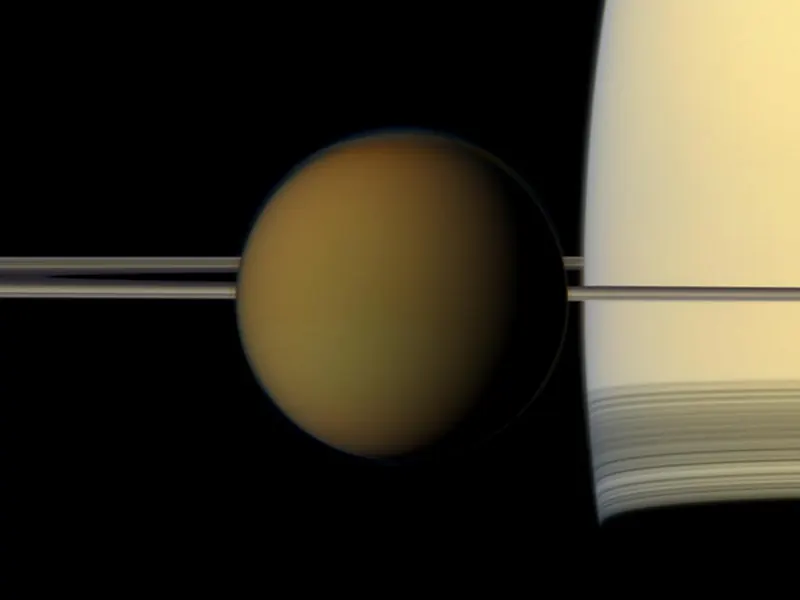
Myth Saturn’s rings always look the same from Earth.
Fact Every so often Earth passes through the plane of the rings and they almost vanish edge-on. Hubble caught it on 22 May 1995. NASA Science: Hubble views Saturn ring-plane crossing One part of NASA’s Hubble page says these ring-plane crossings happen about every 15 years; another says on 13 to 16 year intervals. NASA Science: Hubble views Saturn ring-plane crossing
Myth Saturn’s rings are solid, like a giant record.
Fact They are billions of chunks of ice and rock, mostly from dust-sized grains to pieces as big as a house. A few are as big as mountains. NASA Science: Saturn facts Seen from Saturn’s cloud tops, the rings would look mostly white. Each ring goes round at a different speed. NASA Science: Saturn facts
Myth Saturn’s rings are thick.
Fact The ring system reaches up to 282,000 km from the planet, yet the main rings are typically only about 10 m thick. NASA Science: Saturn facts
Myth You could land on Saturn if you were brave enough.
Fact Saturn has no true surface. It is mostly swirling gases, and liquids deeper down. NASA Science: Saturn facts The pressure and heat deep inside would crush, melt and vaporise any spacecraft trying to fly in. NASA Science: Saturn facts
Myth A planet that big must be heavy enough to sink.
Fact Saturn is the only planet whose average density is less than water’s. NASA says it could float in a bathtub, if a bath that big existed. NASA Science: Saturn facts Saturn’s average density is 687 kg per cubic metre. Earth’s is 5,513. NASA NSSDC: Saturn fact sheet
Myth Saturn has a handful of moons.
Fact Saturn has 293 confirmed moons as of August 2026, says NASA’s Saturn moons page: more than any other planet. NASA Science: Saturn moons · checked 27 Oct 2026 NASA’s Saturn facts page, NASA’s fact sheet, NASA Space Place and ESA still give 274, the count after 128 new moons were announced in March 2025. NASA Science: Saturn facts · checked 27 Oct 2026 NASA NSSDC: Saturn fact sheet · checked 27 Oct 2026 NASA Space Place: All about Saturn · checked 27 Oct 2026 ESA: Facts about Saturn · checked 27 Oct 2026 NASA NSSDC: Saturnian satellite fact sheet · checked 27 Oct 2026
Myth Only Earth has lakes and seas.
Fact Titan is the only place besides Earth known to have liquids on its surface: rain, rivers, lakes and seas of methane and ethane. NASA Science: Titan facts
Myth Storms and winds on giant planets always go round in circles.
Fact Saturn’s north pole has a six-sided jet stream, first noticed in Voyager pictures in the early 1980s. NASA Science: Saturn facts New in 2026: Hubble found a giant, changing, 10-sided wave circling Saturn’s south pole. The study was published in September 2026, using observations going back to 2023. NASA Science: Saturn facts · checked 27 Oct 2026
Myth Cassini is still up there.
Fact On 15 September 2017 Cassini ended its 13-year orbital mission with a planned plunge into Saturn, sending science data to the last second. NASA Science: Saturn exploration It was low on fuel, and NASA chose to end it in Saturn so it could never contaminate Enceladus or Titan. NASA Science: Cassini Grand Finale overview
Myth Galileo discovered Saturn’s rings were rings.
Fact Galileo saw the rings through a telescope in July 1610 but took them for a “triple planet”. NASA Science: Saturn exploration ESA: Saturn’s rings In 1655 Christiaan Huygens worked out that the “ears” were rings, and found Saturn’s biggest moon, Titan. NASA Science: Saturn exploration ESA: Saturn’s rings