Saturn, light enough to float.
A planet less dense than water, rings that stretch wider than they have any right to, a hexagon on its north pole and a moon with methane seas. Every fact checked against NASA, ESA and friends, plus a bath to test the floating, a ringed moon-catching game and an eraser called Useless, who has brought a rubber duck.
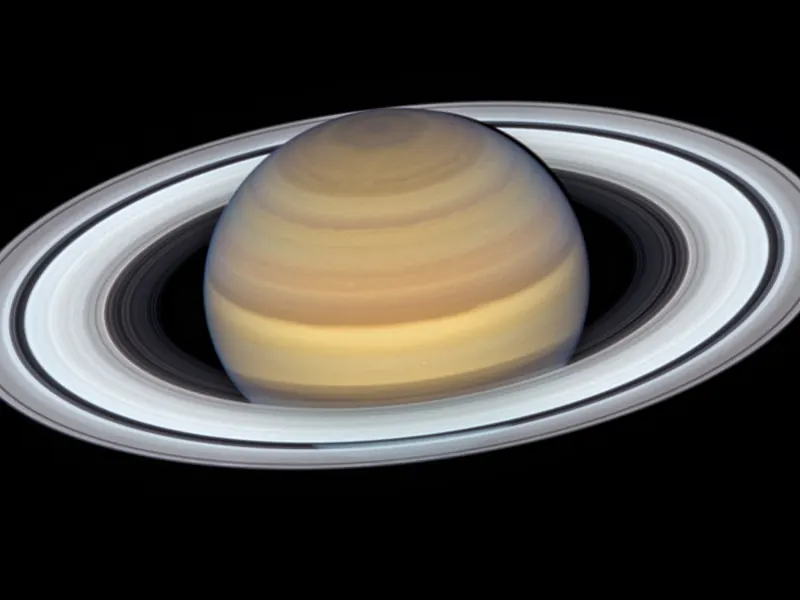
Would it float?
Saturn is the only planet whose average density is less than water’s. NASA says it could float in a bathtub, if a bath that big existed. NASA Science: Saturn facts So we built the bath. Drop Saturn in, then try its moons, and Earth.
Saturn: 687 kg per cubic metre
Our drawing, and a thought experiment: there is no bath that big. Every ball is drawn the same size so you can compare; the real worlds are wildly different sizes.
The densities and where they come from
| World | Density (kg per m³) | In the bath | Source |
|---|---|---|---|
| Saturn | 687 | floats | NASA NSSDC: Saturn fact sheet |
| Hyperion | 550 | floats | NASA NSSDC: Saturnian satellite fact sheet |
| Tethys | 985 | floats | NASA NSSDC: Saturnian satellite fact sheet |
| Iapetus | 1,090 | sinks | NASA NSSDC: Saturnian satellite fact sheet |
| Mimas | 1,150 | sinks | NASA NSSDC: Saturnian satellite fact sheet |
| Rhea | 1,240 | sinks | NASA NSSDC: Saturnian satellite fact sheet |
| Dione | 1,480 | sinks | NASA NSSDC: Saturnian satellite fact sheet |
| Enceladus | 1,610 | sinks | NASA NSSDC: Saturnian satellite fact sheet |
| Phoebe | 1,640 | sinks | NASA NSSDC: Saturnian satellite fact sheet |
| Titan | 1,880 | sinks | NASA NSSDC: Saturnian satellite fact sheet |
| Earth | 5,513 | sinks | NASA NSSDC: Saturn fact sheet |
How it works: anything less dense than water floats, and anything denser sinks. Water is roughly 1 gram per millilitre: 1,000 kg per cubic metre. USGS Water Science School: Water density For a floating ball, the share under water is its density divided by water’s; the waterline is our sum. NASA’s Tethys page says its density is 0.97 times that of water, suggesting it is almost all water ice. NASA Science: Tethys Saturn’s figure is an average for the whole planet: saturn has no true surface. It is mostly swirling gases, and liquids deeper down. NASA Science: Saturn facts
The short version
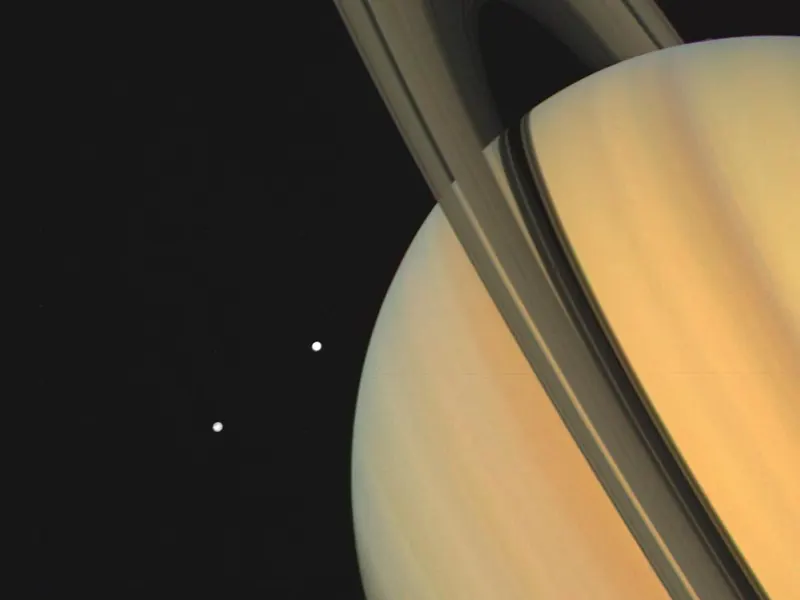
Saturn is the sixth planet from the Sun, and the second largest in the solar system. NASA Science: Saturn facts If Earth were the size of a nickel (a US 5-cent coin), Saturn would be about as big as a volleyball. NASA Science: Saturn facts
Like Jupiter, Saturn is mostly hydrogen and helium, the same two main ingredients as the Sun. NASA Science: Saturn facts Saturn has no true surface. It is mostly swirling gases, and liquids deeper down. NASA Science: Saturn facts
They are billions of chunks of ice and rock, mostly from dust-sized grains to pieces as big as a house. A few are as big as mountains. NASA Science: Saturn facts The ring system reaches up to 282,000 km from the planet, yet the main rings are typically only about 10 m thick. NASA Science: Saturn facts
Titan is Saturn’s largest moon, and the only moon known to have a substantial atmosphere. NASA Science: Titan facts Titan is the only place besides Earth known to have liquids on its surface: rain, rivers, lakes and seas of methane and ethane. NASA Science: Titan facts
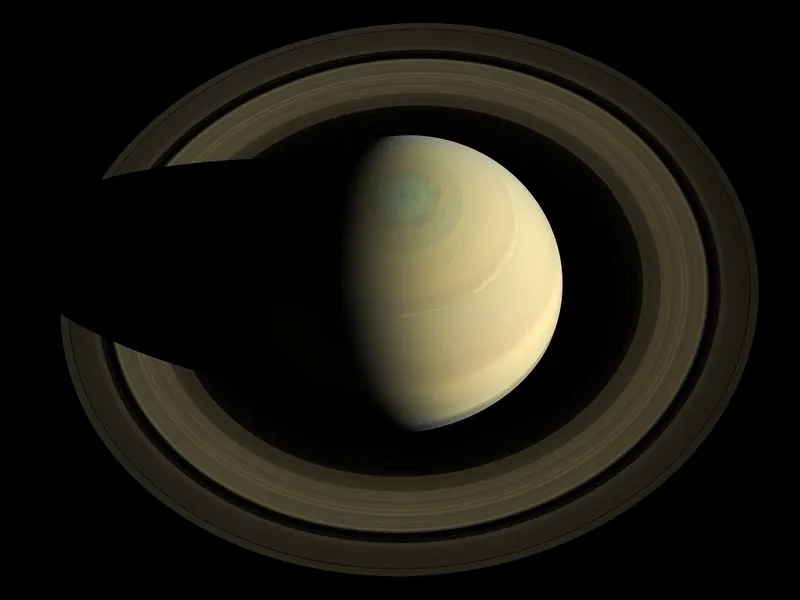
How old, and how heavy, would you be on Saturn?
A Saturn year lasts 10,755.699 Earth days and a Saturn day 10.656 hours. Most people never reach their third Saturn birthday. Nothing you type leaves your browser.
Put in a birthday to find out
- Your age in Saturn years
- –
- Your next Saturn birthday
- –
- Saturn days you’ve lived
- –
- Your weight at Saturn’s cloud tops
- –
How it works: these are our own sums, using NASA’s Saturn fact sheet. A Saturn year is 10,755.699 Earth days NASA NSSDC: Saturn fact sheet; a Saturn day is 10.656 hours NASA NSSDC: Saturn fact sheet. Weight × 1.140 on average, × 0.916 at the equator and × 1.235 at the poles NASA NSSDC: Saturn fact sheet NASA NSSDC: Saturn fact sheet. You couldn’t actually stand there: saturn has no true surface. It is mostly swirling gases, and liquids deeper down. NASA Science: Saturn facts
Explore Saturn
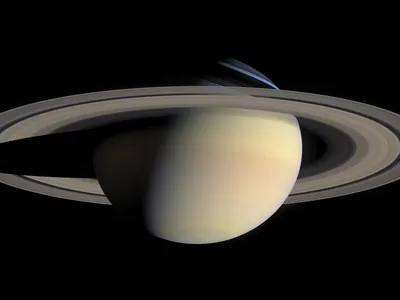 SaturnSize, a 10.7-hour day, gravity and what’s inside.
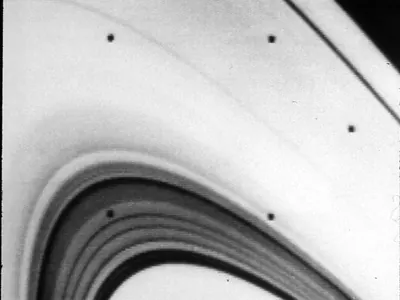 RingsIce, ringlets, the Cassini Division, the hexagon and storms.
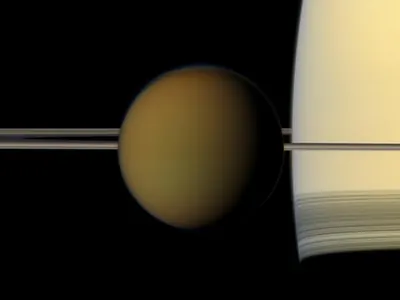 MoonsTitan, Enceladus, Mimas, Iapetus and hundreds more.
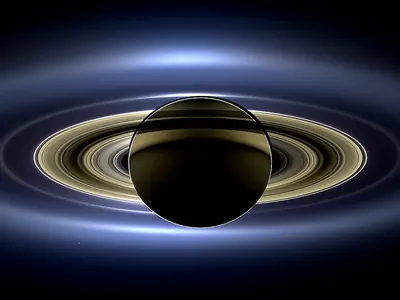 MissionsFrom Pioneer 11 in 1979 to Cassini, Huygens and Dragonfly.
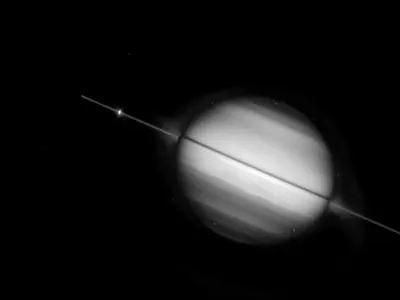 Myths vs factsSolid rings? Somewhere to land? Gently corrected.
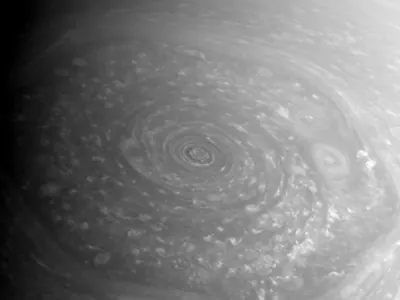 The big facts pageEvery fact on the site, each one checked against its source.
Tile images are credited on their pages and on the credits page.
Things to play
Enjoying Saturn? Help keep the lights on.
This site is hand-built, fact-checked and free to read. If a fact, a game or one of Useless’s notes made you smile, a little support keeps it going and helps the network grow.
Saturn printables
Fact-checked PDFs in A4 and US Letter, sold as instant downloads from the ReallyByte store.
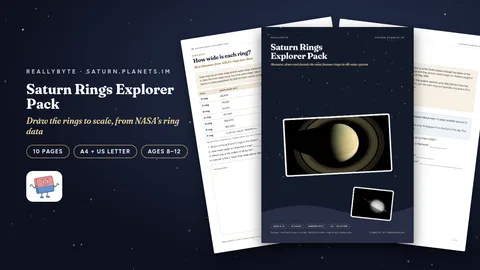
Saturn Rings Explorer Pack
Draw the rings to scale from NASA’s ring distances, put them in order, find the Cassini Division, catch them edge-on and design your own ring, with answer keys
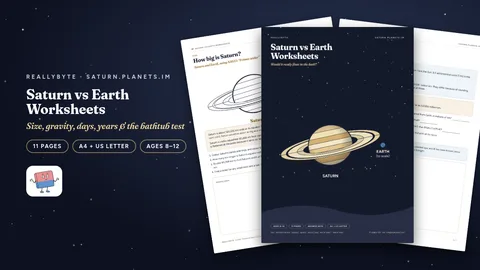
Saturn vs Earth Worksheets
Size, mass, density, days, years and gravity compared, with a bathtub float test, a weigh-yourself page, a cutaway to label and answer keys
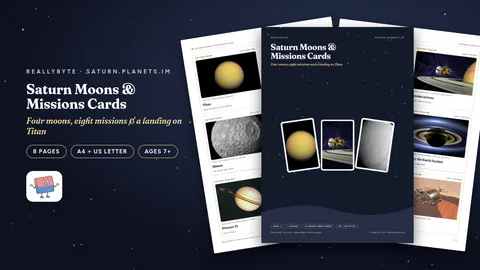
Saturn Moons & Missions Cards
Twelve double-sided cards, from Titan, Enceladus and Mimas to Pioneer 11, Voyager, Cassini, Huygens and Dragonfly, plus a timeline game
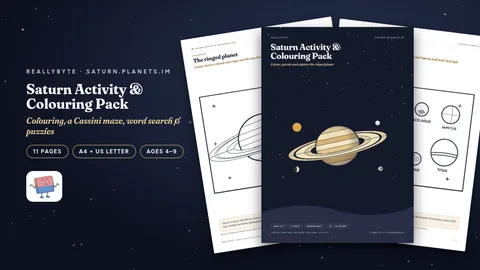
Saturn Activity & Colouring Pack
Colouring scenes, a Cassini maze, word search and puzzles for ages 4 to 9
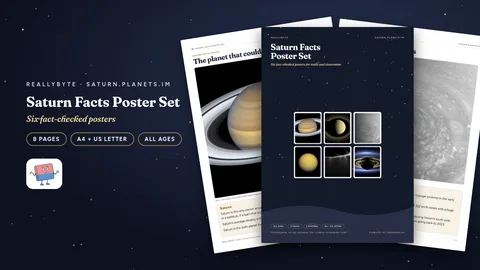
Saturn Facts Poster Set
Six fact-checked posters, from the bathtub planet to the hexagon and Titan’s seas
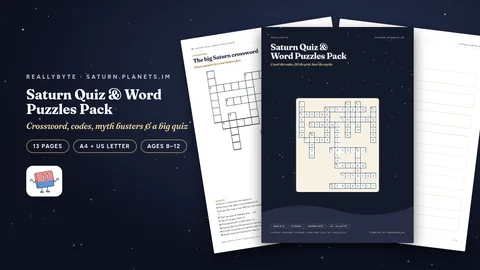
Saturn Quiz & Word Puzzles Pack
A crossword, code breaker, fill-the-gap facts, number match, myth busters and a 16-question quiz, with answer keys
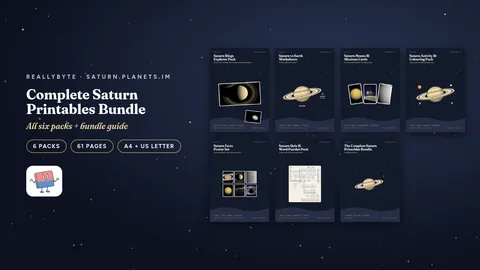 Best value
The Complete Saturn Printables Bundle
All six packs plus a guide, A4 and US Letter, in one download.