Rings, the hexagon and the weather
Billions of chunks of ice going round in a sheet about as thick as a house is tall, plus a six-sided jet stream and, new this year, a ten-sided one.
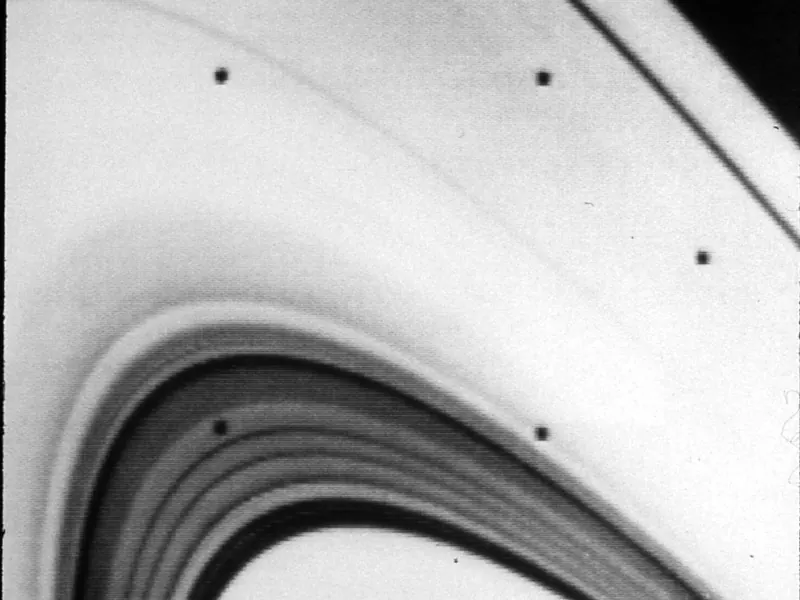
What are they made of?
Saturn’s rings are thought to be pieces of comets, asteroids or shattered moons, torn apart by Saturn’s gravity before they reached the planet. NASA Science: Saturn facts
They are billions of chunks of ice and rock, mostly from dust-sized grains to pieces as big as a house. A few are as big as mountains. NASA Science: Saturn facts ESA says the ring particles are mainly water ice, from microns to metres in size. ESA: Saturn’s rings
Seen from Saturn’s cloud tops, the rings would look mostly white. Each ring goes round at a different speed. NASA Science: Saturn facts
Huge, and incredibly thin
The ring system reaches up to 282,000 km from the planet, yet the main rings are typically only about 10 m thick. NASA Science: Saturn facts
NASA’s rings fact sheet gives thicknesses of about 5 m for the C ring, 5–10 m for the B ring and 10–30 m for the A ring. NASA NSSDC: Saturnian rings fact sheet
NASA’s rings fact sheet puts the outer edge of the faint E ring 480,000 km from Saturn’s centre. NASA NSSDC: Saturnian rings fact sheet
Saturn’s rings, to scale
Drawn from NASA’s rings fact sheet: every band starts and stops where the fact sheet says. The rings are drawn side-on as bands, from Saturn’s centre outwards. NASA NSSDC: Saturnian rings fact sheet
Zoom out, and the faint E ring dwarfs the rest:
Our drawing. Saturn’s radius here is its equatorial radius, 60,268 km NASA NSSDC: Saturn fact sheet. The F ring is very narrow, so it is drawn as a thin line. Thickness is not to scale: at this scale the main rings would be far thinner than a hair.
A, B, C… in the order they were found
Going outwards from Saturn: the D ring, C ring, B ring, the Cassini Division, then the A, F, G and E rings. NASA Science: Saturn facts
The main rings are A, B and C. D, E, F and G are fainter and were found more recently. They are named in the order they were discovered. NASA Science: Saturn facts NASA Space Place counts seven main rings, with spaces between them. NASA Space Place: All about Saturn
The Cassini Division
The Cassini Division, the gap between the A and B rings, is 4,700 km wide. NASA Science: Saturn facts
NASA dates the discovery of the Cassini Division to 1675, by Jean-Dominique Cassini. NASA Science: Saturn exploration ESA’s rings page dates the same discovery to 1676. ESA: Saturn’s rings
Our sum: NASA’s rings fact sheet puts the outer edge of the B ring at 117,507 km and the inner edge of the A ring at 122,340 km, a gap of 4,833 km. That is a little more than the 4,700 km on NASA’s rings page. NASA NSSDC: Saturnian rings fact sheet
From “ears” to rings
Galileo saw the rings through a telescope in July 1610 but took them for a “triple planet”. NASA Science: Saturn exploration ESA: Saturn’s rings At first Galileo wondered if he was looking at three planets, or a planet with handles. NASA Space Place: All about Saturn
In 1655 Christiaan Huygens worked out that the “ears” were rings, and found Saturn’s biggest moon, Titan. NASA Science: Saturn exploration ESA: Saturn’s rings
Strange things in the rings
Cassini studied “spokes” in the rings, which can be longer than Earth is wide. NASA Science: Cassini ring science
Cassini also found “propellers” in the rings, made by moonlets: lumps of ring material. Despite the name, they don’t spin. NASA Science: Cassini ring science
The ring you can’t see
Much further out is the very faint Phoebe ring, in the orbit of the moon Phoebe. NASA Science: Saturn facts In 2009, NASA’s Spitzer Space Telescope found a gigantic, low-density ring linked to the distant moon Phoebe. NASA Science: Saturn exploration
Its spray spreads out round its orbit to make Saturn’s E ring. NASA Science: Enceladus
When the rings vanish
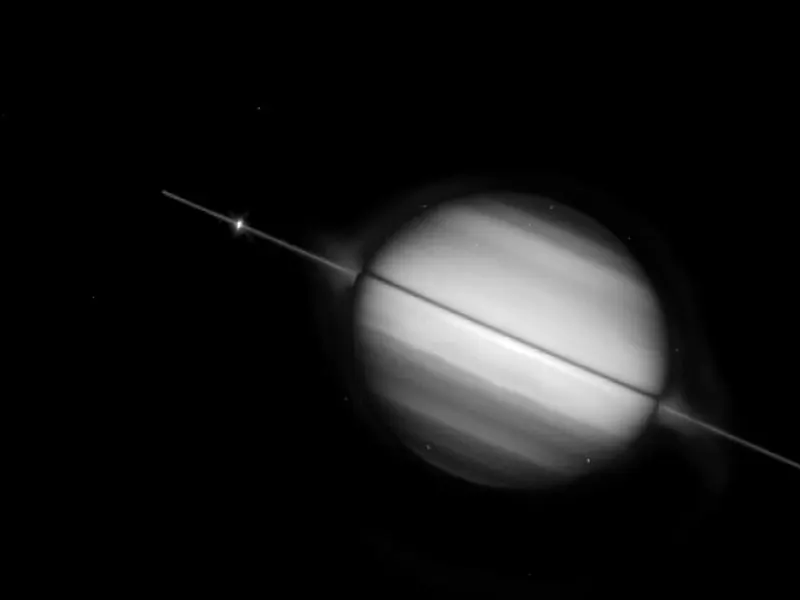
Every so often Earth passes through the plane of the rings and they almost vanish edge-on. Hubble caught it on 22 May 1995. NASA Science: Hubble views Saturn ring-plane crossing
One part of NASA’s Hubble page says these ring-plane crossings happen about every 15 years; another says on 13 to 16 year intervals. NASA Science: Hubble views Saturn ring-plane crossing
The crossing on 23 March 2025 was a poor one to watch: Saturn was only 10 degrees from the Sun in the sky. The next good edge-on views come with the triple passage of 2038–39. NASA Science: Hubble views Saturn ring-plane crossing
The hexagon
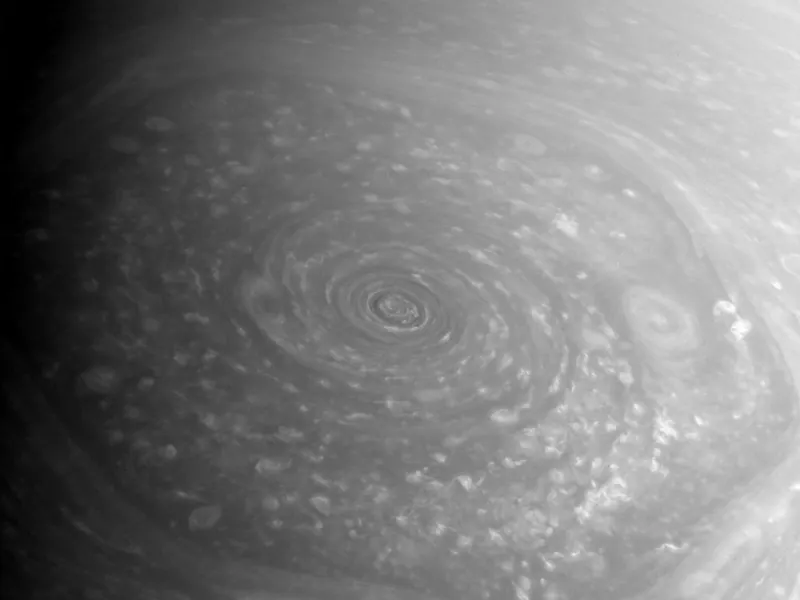
Saturn’s north pole has a six-sided jet stream, first noticed in Voyager pictures in the early 1980s. NASA Science: Saturn facts
The hexagon is about 30,000 km across, a wavy jet stream of 322 km/h winds with a huge spinning storm in the middle. NASA Science: Saturn facts
New: a ten-sided wave in the south
New in 2026: Hubble found a giant, changing, 10-sided wave circling Saturn’s south pole. The study was published in September 2026, using observations going back to 2023. NASA Science: Saturn facts · checked 27 Oct 2026
It is the first time a large, regular-sided jet pattern has been seen in Saturn’s southern half. NASA Science: Saturn facts · checked 27 Oct 2026
Wind and storms
NASA’s Saturn facts page says winds in the upper atmosphere reach 500 m a second near the equator. Earth’s strongest hurricane winds top out at about 110 m a second. NASA Science: Saturn facts
NASA’s fact sheet gives wind speeds of up to 400 m a second within 30 degrees of the equator, and up to 150 m a second further north and south. NASA NSSDC: Saturn fact sheet
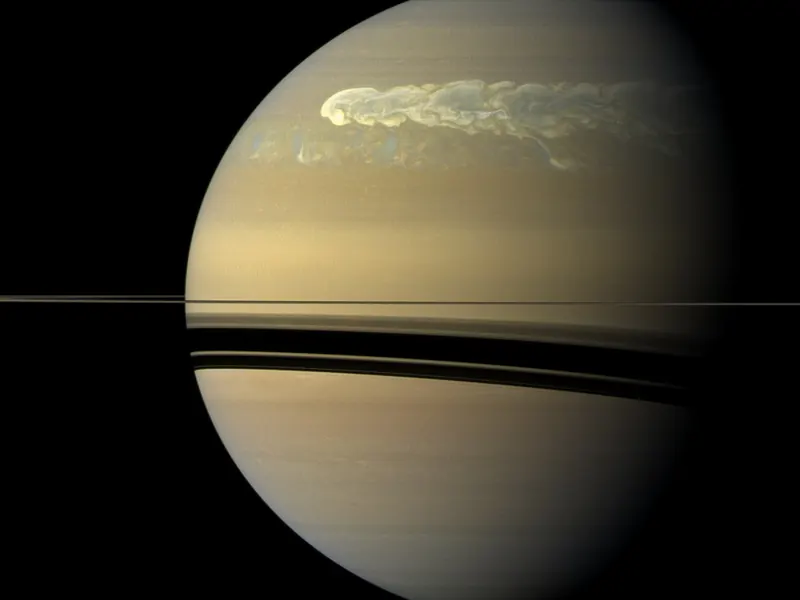
Saturn’s clouds show as faint stripes, jet streams and storms, in shades of yellow, brown and grey. NASA Science: Saturn facts
Next: moons →